


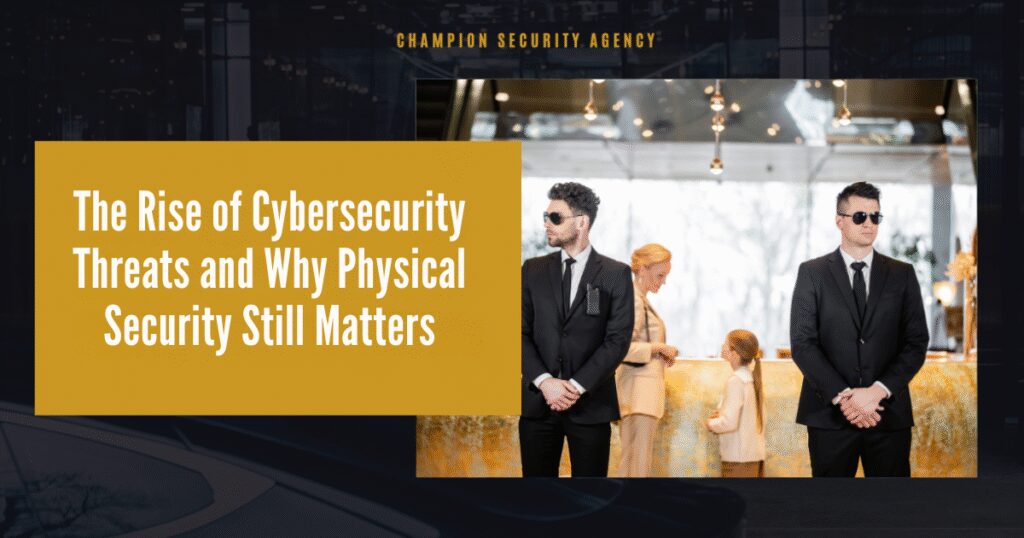
The Rise of Cybersecurity Threats and Why Physical Security Still Matters
We live in an era where data is often more valuable than gold. From cloud storage to smart offices, businesses today depend on digital systems for nearly everything. But with that convenience comes a rising wave of cybersecurity threats — hackers, phishing scams, ransomware attacks — you name it.
Yet, while everyone is talking about protecting their digital assets, there’s one area many companies overlook: physical security. Because here’s the truth — even the strongest firewall can’t stop someone from walking through your front door.
Let’s break down why physical security is still the first and last line of defense in a world obsessed with digital protection.
The Surge in Cybersecurity Threats
It’s no secret that cybercrime is booming. Every year, attacks get smarter, faster, and more devastating.
A Growing Digital Battlefield
According to recent studies, global cybercrime costs are projected to exceed $10 trillion annually by 2025. Businesses of all sizes — from small startups to multinational corporations — are targets.
Cybercriminals exploit every weak spot possible, whether it’s a forgotten software update, a weak password, or a careless employee clicking the wrong email link.
Common Cyber Threats Businesses Face
-
Ransomware: Hackers lock your data and demand payment to release it.
-
Phishing: Deceptive emails trick employees into sharing sensitive information.
-
Data breaches: Personal and financial data gets stolen and sold online.
-
Denial-of-service (DoS) attacks: Systems are flooded with traffic until they crash.
-
Insider threats: Sometimes, the risk comes from within — an employee mishandling data or intentionally causing harm.
All of these can cripple operations, damage reputation, and drain resources. It’s no wonder cybersecurity has become a top business priority.
But amid the rush to fortify digital systems, many forget that cyber and physical security are deeply connected.
The Overlooked Weak Spot: Physical Access
Imagine spending thousands on cybersecurity software — only for someone to steal a laptop, plug in a rogue USB, or sneak into your server room.
That’s not science fiction; it’s a real-world risk. Many cyberattacks start with a physical breach. For example:
-
A thief steals company hardware with sensitive data.
-
An intruder plants a malware-loaded USB drive.
-
A disgruntled ex-employee accesses restricted areas.
In each case, the entry point isn’t digital — it’s physical.
When Physical and Cyber Worlds Collide
Modern offices are filled with connected devices — smart locks, security cameras, sensors, and computers — all part of the Internet of Things (IoT). While these tools improve efficiency, they also open new vulnerabilities.
A compromised security camera, for instance, can become a hacker’s gateway into your entire network. So, even though the threat seems “cyber,” the root cause is often a lapse in physical security.
Why Physical Security Still Matters
Physical security may sound old-school, but it’s more important now than ever. It’s the foundation on which all digital security efforts stand.
1. It Protects Critical Infrastructure
Think about your business assets — servers, data centers, employee devices, and networking equipment. These physical elements store and process your most sensitive data.
If someone gains unauthorized access to them, no cybersecurity software can save you. Secure locks, ID badges, and monitored access points are your first barrier against infiltration.
2. Prevents Insider Threats
Not all threats come from the outside. Employees, contractors, or visitors might accidentally or intentionally compromise your systems.
Physical access controls — like smart card systems, biometric scanners, and visitor logs — help track who enters restricted areas and when. This accountability can prevent unauthorized activities before they start.
3. Supports Business Continuity
Fires, floods, or power outages can disrupt operations and damage data systems. Physical safeguards such as fire suppression systems, climate control, and secure server enclosures help protect your equipment and ensure faster recovery after a disaster.
4. Enhances Employee Safety
Security isn’t just about data — it’s also about people. Access control, surveillance, and emergency response systems protect staff from threats like intruders, workplace violence, or accidents.
A secure work environment fosters confidence and productivity — because employees can focus on their jobs, not their safety.
Integrating Cyber and Physical Security: The Smart Way Forward
In the modern world, separating cyber and physical security doesn’t make sense anymore. The two must work hand in hand.
Step 1: Conduct a Unified Risk Assessment
Start by identifying all potential risks — both physical and digital.
Ask questions like:
-
Who has access to our server rooms and data centers?
-
Are our IoT devices secured against hacking attempts?
-
Do we monitor physical entries and exits effectively?
A comprehensive risk audit reveals where your systems overlap and where they might fail.
Step 2: Strengthen Access Control Systems
Access control is the bridge between cyber and physical protection.
Use smart ID cards, biometric systems, and multi-factor authentication to regulate entry. These tools ensure only authorized personnel can access sensitive areas or systems — and every action is logged for accountability.
Step 3: Implement Video Surveillance and Monitoring
Modern surveillance systems do more than just record — they analyze behavior and alert you to suspicious activity.
Integrating AI-powered cameras with cybersecurity systems allows real-time alerts if someone tampers with equipment or enters restricted zones.
Step 4: Train Employees Continuously
Human error remains the biggest security risk. Regular training sessions can teach employees to:
-
Recognize phishing and social engineering attempts.
-
Protect their login credentials.
-
Report suspicious activities promptly.
Awareness builds a culture of security where every employee becomes part of the defense system.
Step 5: Prepare for the Unexpected
Even the best systems can be breached. That’s why emergency response planning is essential.
Develop clear protocols for cyber incidents, physical breaches, and natural disasters. Assign roles, run drills, and ensure your team knows exactly what to do under pressure.
The Cost of Ignoring Physical Security
Businesses that focus solely on cybersecurity often pay a high price when physical breaches occur.
Consider these real-world consequences:
-
A lost or stolen laptop with unencrypted data can expose customer information.
-
A rogue visitor accessing the server room can install malware undetected.
-
Damaged hardware from fire or theft can disrupt operations for weeks.
In short, you can’t have cybersecurity without physical security. The two are interdependent, forming a complete protection strategy.
The Future: Converged Security Systems
The next wave of business protection lies in converged security — the seamless integration of digital and physical systems.
Companies are adopting centralized platforms that monitor everything from network traffic to building access in real time. This unified view allows faster response, better data sharing, and smarter decisions.
Artificial Intelligence (AI) and the Internet of Things (IoT) will continue to play massive roles. AI-driven surveillance, smart locks, and predictive analytics can identify threats before they escalate — combining data from both physical and digital realms for maximum security.
Final Thoughts
The rise of cybersecurity threats has changed how businesses think about protection, but it shouldn’t make us forget the basics. Firewalls, encryption, and antivirus tools are crucial — but they’re only half the equation.
Physical security remains the backbone of every successful security strategy. Without it, even the most advanced cybersecurity measures can crumble.
So while you’re busy defending your data from hackers, remember this: your first line of defense might just be your front door.