


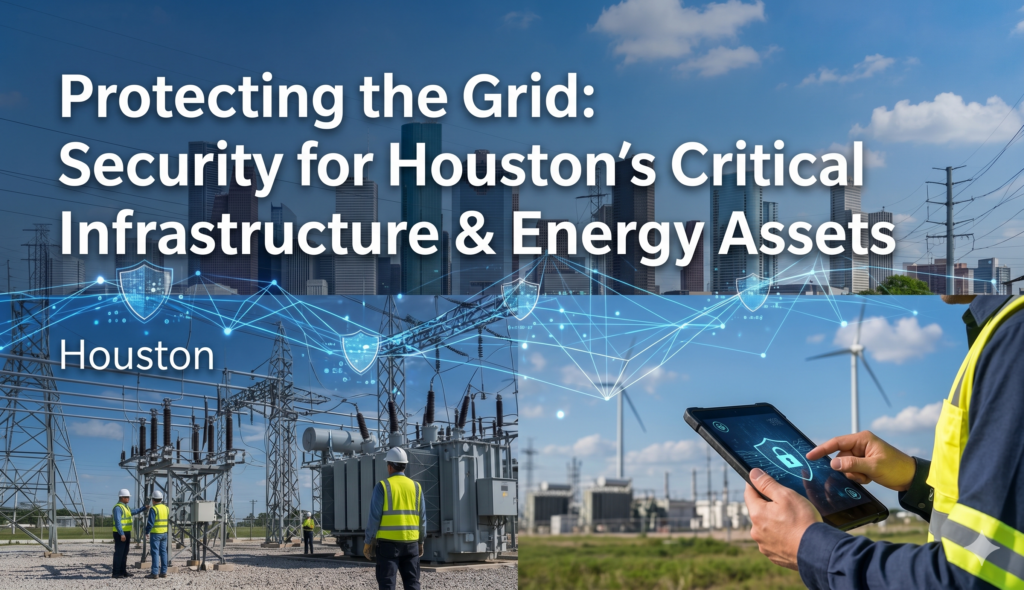
Protecting the Grid: Security for Houston’s Critical Infrastructure & Energy Assets
Houston is not merely a city in Texas; it is the undisputed energy capital of the world. From the massive refineries lining the Houston Ship Channel to the intricate midstream networks and the utility grids powering millions, the region’s infrastructure is the heartbeat of the global economy.
However, being a global hub comes with significant risk. Protecting these assets requires more than just a chain-link fence—it demands an integrated, high-level security strategy that blends advanced technology with rapid emergency response.
The Strategic Importance of the Houston Energy Sector
The Houston area houses one of the world’s largest petrochemical manufacturing clusters. This concentration of assets creates a unique security landscape where a single breach can have cascading effects on global supply chains and national security.
1. The Houston Ship Channel: A Global Target
The Ship Channel is a 52-mile-long complex of public and private terminals. It handles more foreign waterborne tonnage than any other U.S. port. Security for oil and gas facilities here involves managing massive perimeters where land meets sea, requiring specialized maritime security protocols alongside traditional land-based protection.
2. Refining and Midstream Facilities
Refineries are high-hazard environments. Security personnel must be trained not just in defense, but in safety protocols (HSE) to ensure that security measures do not interfere with emergency shut-off procedures or volatile chemical storage.
Modern Challenges in Protecting Critical Infrastructure in Texas
As the “Texas Triangle” continues to grow, the threats facing the energy sector have evolved. Security providers are now defending against a three-pronged threat: physical intrusion, domestic extremism, and sophisticated vandalism.
Physical Perimeter Vulnerabilities
Large-scale facilities often have miles of perimeter. Traditional patrolling is often insufficient for early detection. The goal in 2026 is proactive detection—identifying a threat before it reaches the fence line.
Regulatory Compliance
Energy assets must adhere to strict federal and state regulations, including:
-
CFATS (Chemical Facility Anti-Terrorism Standards): Ensuring high-risk chemical facilities have specific security measures.
-
NERC CIP: Standards for the security of the bulk power system.
-
MTSA (Maritime Transportation Security Act): Critical for facilities along the Ship Channel.
Integrated Security Solutions for the Energy Sector
Effective Houston energy sector security relies on a multi-layered approach. When protecting critical infrastructure, security must be “baked in” to the operational DNA of the facility.
High-End Surveillance and Real-Time Analytics
Modern security utilizes AI-driven surveillance. Thermal imaging cameras can detect body heat signatures in the dead of night along a dark pipeline, while video analytics can distinguish between a stray animal and a human intruder.
Executive Protection and Access Control
Access control in refineries is about more than just keeping people out; it’s about knowing exactly who is on-site during an emergency. Biometric scanners and “smart” badge systems ensure that only certified personnel enter hazardous zones.
Drone Surveillance and Counter-UAS
Large midstream facilities and pipeline networks are increasingly monitored by drones. Conversely, “Counter-UAS” (Unmanned Aircraft Systems) technology is becoming vital to prevent unauthorized drones from conducting surveillance or dropping payloads on sensitive equipment.
Emergency Response: The Critical Second Half
Security is not just about prevention; it is about what happens when things go wrong. For Houston’s energy assets, the emergency response component is non-negotiable.
Specialized Guarding
Guards at energy sites are often “security-plus” roles. They are frequently trained as first responders or EMTs, capable of coordinating with the Houston Police Department (HPD) or the Harris County Sheriff’s Office during a large-scale incident.
Crisis Management and Drills
Protecting critical infrastructure in Texas requires regular “Red Team” exercises—simulated breaches that test the response time of both on-site security and local law enforcement.
The Future of Energy Security in Houston
As the industry pivots toward “Energy 2.0” and incorporates more renewable sources and hydrogen hubs, the grid becomes more decentralized. This decentralization creates more “nodes” that require protection.
Hardening the Grid
“Hardening” involves physical reinforcements—ballistic-resistant barriers around transformers and substations—as well as technological hardening against electromagnetic interference.
Sustainable Security Operations
In alignment with the energy sector’s ESG (Environmental, Social, and Governance) goals, security providers are now utilizing solar-powered mobile surveillance trailers and electric patrol vehicles to minimize the carbon footprint of the security operation itself.
Conclusion: Securing the Backbone of Houston
Protecting Houston’s critical infrastructure is a massive responsibility that requires a partner who understands the local landscape. From the Ship Channel to the refineries of Baytown and Deer Park, the security of our energy assets is the security of our future.
By investing in high-level perimeter protection, integrated AI surveillance, and elite emergency response teams, Houston’s energy giants can ensure that the “Energy Capital of the World” remains safe, resilient, and operational—no matter what threats emerge.