


Licensed vs. Unlicensed Security: The Risks to Your Houston Business
In the competitive Houston business landscape, “budget” is a word that often leads to compromise. While cutting costs on office supplies or software might save a few dollars, cutting corners on physical security can cost you your company.
Currently, many Houston-based firms are undercutting the market by deploying unlicensed staff—unvetted individuals who lack the legal authority and training to protect your assets. To the untrained eye, a uniform is just a uniform. However, under the hood of Texas law, the difference between a licensed professional and an unlicensed “guard” is the difference between a solid shield and a massive liability.

The Legal Reality: Texas DPS Security Requirements
In Texas, private security is strictly regulated under Texas Occupations Code Chapter 1702. The Texas Department of Public Safety (DPS) mandates that any individual performing security-related duties—whether armed or unarmed—must be licensed.
There are no “loopholes” for small businesses or temporary events. Hiring an unlicensed security company or individual isn’t just a bad business move; in many cases, it is a violation of state law.
Understanding the Licensing Tiers:
-
Level II (Unarmed): This is the baseline. It requires state-approved training on legal responsibilities, patrol procedures, and emergency response.
-
Level III (Armed): These officers undergo rigorous firearms proficiency, defensive tactics, and advanced legal training regarding the use of force.
-
Level IV (Personal Protection): Specialized training for executive protection.
Hiring a firm that bypasses these Texas DPS security requirements means you are entrusting your staff, customers, and property to someone who hasn’t cleared a fingerprint-based background check or completed state-mandated de-escalation training.
The “Budget” Trap: Why Cheap Security is Expensive
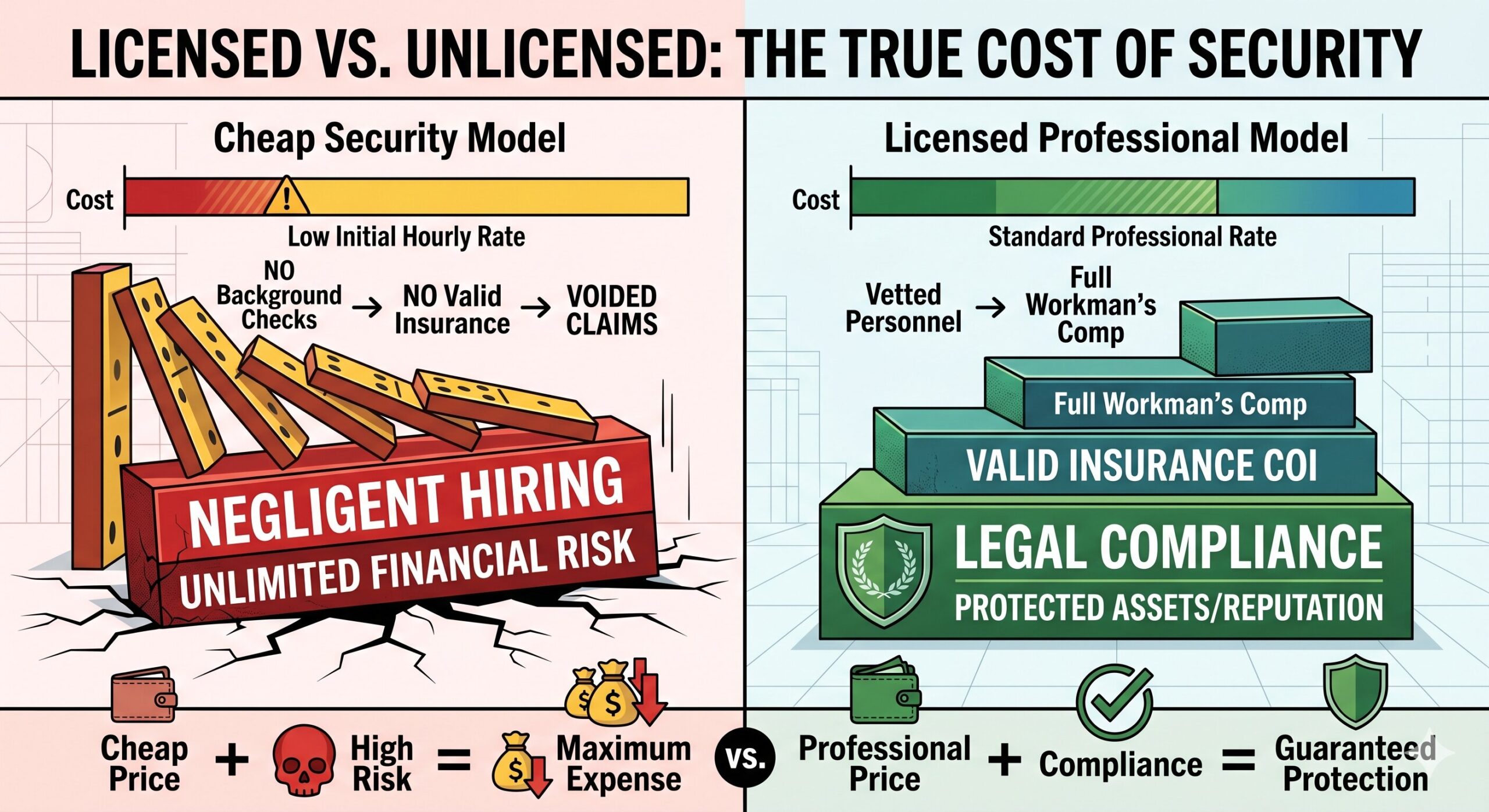
It’s a common scenario in Houston: a business owner receives a quote that is 30% lower than the market average. To hit that price point, the security firm often skips the “expensive” parts of the business: background checks, workers’ compensation, and—most importantly—licensing.
When you hire these firms, you aren’t just saving money; you are inheriting their risk. If an unlicensed guard gets into a physical altercation or fails to stop a crime, the legal “corporate veil” that usually protects your business can quickly vanish.
The Insurance Nightmare: Is Your Coverage Void?
This is the risk most Houston business owners don’t see coming until it’s too late. Most General Liability and Professional Liability insurance policies contain “Compliance with Law” clauses.
If an incident occurs—such as a slip-and-fall, a theft, or an assault—and your insurance provider discovers that the security personnel involved were unlicensed, they may deny your claim entirely.
The logic from the insurer’s perspective is simple: you hired an illegal service, therefore the risk was not part of the agreed policy. Without insurance coverage, your business is directly responsible for:
-
Legal defense fees (which can reach six figures easily).
-
Settlements or court-ordered damages.
-
Medical bills for injured parties.
Vicarious Liability: “The Boss Has to Answer”
Under the Texas legal principle of respondeat superior (vicarious liability), an employer is held responsible for the actions of their employees or contractors. If an unlicensed guard uses excessive force or behaves with negligence, a Houston court will look at who hired them.
By hiring an unlicensed company, you have committed negligent hiring. Plaintiffs’ attorneys in Texas look for these gaps. They will argue that by failing to verify the license of your security provider, you demonstrated a “reckless disregard” for public safety. This often leads to punitive damages, which are designed to punish the business and are rarely covered by insurance.
HPD-Level Standards: The Professional Difference
When we talk about “HPD-level standards,” we are referring to a level of professionalism, discipline, and legal adherence that mirrors the Houston Police Department.
Licensed security companies in Houston that operate at this level provide more than just a presence; they provide a legal buffer. A professional firm ensures:
- Strict Vetting: Every officer has cleared a fingerprint-based criminal history check.
- Continuous Training: Officers don’t just “get a card”; they undergo regular training in situational awareness and the latest Texas security laws.
- Comprehensive Coverage: They carry the $1M/$2M liability limits (or higher) required to protect high-stakes Houston enterprises.
- Accountability: Detailed digital reporting and GPS tracking ensure that when you pay for security, you are actually getting it.
How to Protect Your Business: A Checklist
Before signing a contract with a security firm in Houston, perform these three non-negotiable checks:
- Verify the Company License: Ask for the company’s “B” license number and verify it on the Texas DPS Private Security website.
- Request an Insurance COI: Don’t just take their word for it. Request a Certificate of Insurance (COI) that lists your business as an “Additionally Insured” party.
- Ask for Proof of Guard Registration: For any guard posted at your site, you have the right to see their pocket card—the state-issued ID that proves they are currently licensed.
Conclusion: Don’t Gamble with Your Assets
In a city as dynamic as Houston, your business is an asset worth protecting. The “savings” offered by unlicensed firms are an illusion—a temporary discount that sets the stage for a permanent financial disaster.
By insisting on licensed security companies in Houston, you aren’t just buying “guards.” You are buying peace of mind, legal protection, and a professional standard that reflects the quality of your own brand.